
The Digital Piano Bible
The Digital Piano Bible
7 Things You MUST Know Before You Buy a Digital Piano

Author: Graham Howard (updated regularly)
“The digital piano buyer’s guide will help you choose a
piano that’s right for you and your family”, Graham Howard
You’re welcome to print out this guide for personal use,
but please note, there’s about 75 pages.
Sorry, I got a bit carried away with it!
If you’ve just started out looking for a digital piano,
or you’ve been researching for a while and can’t
make that important final decision then you’ll find
the information in this book invaluable…
This book will help you make the right decisions
and, probably even more importantly, stop you
from making VERY expensive mistakes.
Buying a digital piano isn’t something you do often.
Well, hopefully not if you get it right the first time!
After you’ve digested the detailed information
this book you will no longer be an easy target
for salespeople…
In fact, you’ll most likely be more knowledgeable
than the salesperson themselves!
I wish you many years of enjoyment with your,
soon to be, new digital piano.
Oh, and just one more thing…
I update this book often, so if you want the
latest copy, just send me an email:
grahamhoward@ukpianos.co.uk
Here’s what you’re going to get:
1) How to Understand Confusing Terminology
(‘Piano Geek Speak’)
You’re going to find out what the following terms mean:
(a) Weighted keys
(b) Touch sensitive keys (and dynamic levels)
(c) Graded hammer action
(d) Mechanism with escapement
(e) Key weight control
(f) GHS/GH/GH3 key touch
(g) Keyboard split
(h) Polyphony
(i) Midi IN/OUT (USB)
(j) Aux IN/OUT
(k) Record facility
(l) Built-in metronome
(m) Speaker wattage
(n) Transpose
(o) Reverb
(p) Dual voice
(q) String resonance
(r) Key off sample
(s) Brilliance
(t) Scale tuning
(u) Display screen
2) Common Digital Piano Questions
(a) Are wooden keys better than plastic keys?
(b) How much polyphony do I need: 32, 64, 96, 128 or more?
(c) How much speaker wattage do I need?
(d) What’s the difference between digital and stage pianos?
(e) Where are the best and worst places in my home to put a digital piano?
(f) How do I protect my piano from drink spills, dust and cup stains?
(g) Are wooden mechanisms a good thing, or could they be a risky purchase?
(h) Are warranties transferable on digital pianos?
(i) What’s the average life of a digital piano?
3) The Disadvantages of Buying a Second hand
Digital Piano, Versus a New One
4) 6 Simple Tests You Can Do In A Piano Store
Before Making Your Decision. DON’T BUY If
The Digital Piano Doesn’t Pass All 6!
(a) Stand at a distance and get someone to play
(b) Turn the volume off, or right down. Are the keys noisy or clicky?
(c) Do the keys move a lot from side to side?
(d) Are the keys touch sensitive?
(e) How much resistance (weight) do you feel on the keys?
(f) How long does the sound sustain?
5) A Complete List of Digital Piano Brands.
And The Top Digital Piano Brands Scored On:
(a) Selection (top 6 brands)
(b) Reliability (top 10 brands)
(c) Long term popularity (top 5 brands)
(d) Recent popularity (top 5 brands)
(e) Overall result (top 18 brands)
6) Which Digital Pianos Are The Best?
(a) The top ten lists of piano models. Rated on a
combination of touch, sound, design, build quality,
reliability, resale value, popularity, and value for money
(b) The top ten list of piano models in each of four categories:
the best under £500, the best from £500 to £800, the best
from £800 to £1200, and the best over £1200
7) Should You Buy Online Or In A Physical Store?
(a) The advantages and disadvantages of both
(b) A list of trusted online and offline stores – (website and contact details included)
(c) Two simple ways to find out if a store is legitimate
(d) How to GUARANTEE your money is safe when you buy online – even if the store goes bust!
… So let’s get started!
1) How to Understand Confusing Terminology
(‘Piano Geek Speak‘)
Are you confused about all the different
terminology that’s being used?
If you are, then I’m not surprised!
Here’s a typical scenario…
You walk into a piano shop and you’re greeted
with a warm “hello, how can I help you?”
You explain that you want to buy a piano for
your son or daughter, and you need some advice.
Should be simple, right?
Well…
The salesperson starts to ramble on about GHE
and GH mechanisms, polyphony, graded
hammer action, touch sensitivity, escapement,
dual voice, split keyboard, etc.
This is something you probably didn’t expect.
After all, how can buying a piano be so complicated?
So you walk out of the shop completely confused.
You then go online to do some research.
This is when it gets even worse…
The same terminology you heard in the piano
shop starts appearing in the descriptions
of the pianos on websites.
What does it all mean?
There are many, many different terms used to
describe the different parts and functions of
the piano. Manufacturers also use their own
wording as well.
Now I’m going to explain the most common terms.
So the next time you’re confronted with
‘Piano Geek Speak’, you’ll nod your head in
complete understanding.
Here we go…
(a) Weighted keys
Most digital pianos have different key weighting.
You’ll likely come across terminology such as:
- Light-weighted
- Semi-weighted
- Weighted
- Medium-weighted
- Fully-weighted
The difference between the above key weights
is only slight.
Ideally you should aim to get a piano that has
a fully weighted touch. These pianos are usually
more expensive though…
So, settling for a medium-weighted key touch is
the next best option.
Please note: Manufacturers usually write their
own piano descriptions. So THEY choose the
terminology to describe their key touch.
This can often be very misleading…
I’ve seen pianos described as having fully-
weighted keys, when they really only have
medium-weighted keys.
On the other end of the scale I’ve seen pianos
described as fully-weighted keys – but their
touch is WAY too heavy, and has so much
resistance that a master rock climber would
get finger ache playing them!
It’s not good to learn on such a piano…
If you spend too much time pressing down on
hard or stiff, heavily resistant keys, you’ll end
up with a very poor technique…
And you’ll find it extremely difficult to control
the key touch on an upright or grand piano.
I’ve seen it happen so many times.
These pianos are misleadingly advertised as
‘weighted’, and, really, should be renamed
‘super heavy-weighted’ (like the big boxers).
Tip/
Pianos that have a ‘super heavy-weighted’
key touch are usually easy to spot.
Here are some give-away signs to look out for:
(i) They usually sell between £299 and £400.
But I’ve seen some selling at higher prices
(ii) Sometimes they’re marked down from an
extremely inflated ‘retail’ price that gives
the appearance of a ‘real bargain’
(iii) They’re not one of the well-known brand
names. And they certainly don’t appear in the
top 10 or top 20 lists you’ll see later in this book.
If you’ve seen a brand new piano for sale in the
£299 to £400 price range that didn’t make my
top 10 under £500 list, be very cautious!
If you have any doubts at all just send me
an email: grahamhoward@ukpianos.co.uk
The list below describes the ‘actual’ key
weight of the most popular makes and models.
I put together this list over a 6 month period
by playing, feeling and testing the weight
and resistance of the piano key’s down stroke
and up stroke.
Light-weighted
Examples of light-weighted keys:
- Yamaha PSR, EZ, YPT, DGX230, DGX530,
NP11, NP31, NP-V60, NP-V80 - Casio CTK and LK models
- Korg PA models
Digital pianos can have semi-weighted, weighted,
medium-weighted or fully-weighted keys…
This means the key touch is heavier than typical
61 key electronic keyboards with a light-weighted
key touch.
Fully-weighted keys feel closest to an upright
or grand piano.
Semi-weighted
Examples of semi-weighted keys:
- Chase (all models)
- Gear4Music (SP, SDP, DP, GDP, JDP and V models)
- Hemingway (all models)
- Donner (all models)
- Suzuki (all models)
- Thomann (All models except DP50)
- Williams (all models)
Weighted
Examples of weighted keys:
- Casio CDP130, CDP220, CDP230, S100, S350
- Galileo (all models)
- Orla (all models)
- Thomann DP50, DP95, DP2000, DP3000, DP6000
Medium-Weighted
Examples of medium-weighted keys:
- Broadway B2
- Hadley S1, Thomann DP26
- Kawai CL36, CL37, KDP90, KDP110, ES100, ES110
- Korg B1, B2, SP170S, SP280, LP380
- Kurzweil KA110, KDP100, KDP110
- Yamaha DGX660, P45, P115, P125, YDP143, YDP144, YDP-V240
Fully-Weighted
Examples of fully-weighted keys:
- Broadway AB1, EZ-102, B1, BW1, B3, BG2, MK10, MK11
- Casio AP Celviano and PX Privia range
- Classenti CDP1, CDP2, CDP3, CDP3i, H1, H2, UD1, DG1, GR1i
- Gewa PP-3, DP510, CP510, DP520, UP540, DP300G, DP345, UP355, UP395, UP405
- Hadley D10, D20, D30, D40
- Kawai CN27, CN29, CN37, CN39, CA17, CA18, CA48, CA58, CA78,
CA67, CA97, CA98, CS4, CS7, CS11, ES8 - Kurzweil KA90, M110, MP15, MP120, M3W, MPS10, MPS110, MPS20,
MPS120, MP10F, CUP320, CUP1, CUP2A, CGP220W - Roland RP102, RP301, RP501R, F140R, RD800, F20, F120, FP50,
FP80, HP702, HP704, HPi-50e, LX705, LX17, DP603, DP90 - Yamaha YDP-S34, YDP-S52, YDP164, YDP165, CLP825, CLP835,
CLP845, CLP875, CLP885, CLP865GP, CVP701, CVP705, CVP709,
CVP709GP, CVP801, CVP805, CVP809, CSP150, CSP170, P255,
CP73, CP300, NU1, N1, N2, N3X
Notes: Fully-weighted feel closest to playing a real piano.
(b) Touch sensitive keys (and dynamic levels)
When you press the piano key down softly, you
hear a quiet sound. When you press it with
force, you hear a loud sound. And there are
various degrees in between.
‘Touch sensitive’ means: the harder you strike
the key, the louder the sound. Or, to be
technically correct, the faster the key goes
down, the louder the sound.
So, it’s very important to buy a digital piano
that has as many touch sensitive levels as
possible.
Now here comes the confusing part.
Different terminology is used by manufacturers
to describe these different levels of touch
sensitivity.
Here are some of the common jargon words
you’ll come across:
- Touch sensitivity levels
- Touch response levels
- Dynamic levels
What gets even more confusing is when the
above terms are incorrectly used to describe
something completely different. For example
key weight…
Some pianos have a feature that allows you
to set the key weight to ‘feel’ differently when
you play. So you can get a louder sound by
pressing the keys down lightly, for instance.
But I won’t go into this right now.
So… now back to touch sensitive keys…
The term I will use from now on to describe
how many levels of touch sensitivity a piano
has is: ‘Dynamic levels’.
If you want to cut through the jargon and really
know how many dynamic levels a specific piano
has, then just send an email to: grahamhoward@ukpianos.co.uk
and I’ll tell you.
If you practice on a piano or keyboard that
doesn’t have dynamic levels you’ll end up with
bad habits and a very poor technique.
This is a real disaster because if you ever want
to play a real piano, you’ll find it really difficult
to adapt.
Digital pianos vary in the number of dynamic
levels they offer. You get anything from 1 to 6
levels.
Most cheap digital pianos have between 1 and
3 levels. But the more levels the better!
The more popular makes such as Yamaha,
Roland, Kawai, Kurzweil, Gewa, Casio, Broadway,
and Classenti have between 3 to 6 dynamic levels.
Most of their basic pianos have 3 or 4 levels,
their mid-range has 4 levels, and their very
best pianos have 5 or 6 levels.
Here’s what dynamic levels means:
Pushing down a piano key with a different force
produces a louder or softer sound. It has nothing
to do with the weight of the key; only the force
required to adjust the sound of each note.
So, hitting the key hard produces a loud sound,
and pushing it down gently produces a soft sound.
A real, acoustic piano has a huge number of
dynamic levels. It all depends on the velocity of
the hammer as it strikes the string. But even the
highly trained ear of a piano tuner can distinguish
only 6 or 7, or maybe 8 at a struggle.
Digital pianos try to replicate this. Some do it
quite well, and others, poorly.
Important:
A minimum of 4 dynamic levels is essential.
If you practice on a digital piano that has a
restricted number of dynamic levels, you will
develop a poor technique. You’ll find it really
difficult to play music with expression.
This is a serious disadvantage because most
music changes in volume.
What’s more, when the time comes to play an
upright or grand piano, you’ll struggle to adapt…
and you’ll find yourself playing too loudly most
of the time. This is because you’ve been used
to thumping the keys to get a louder sound.
So you’ll have to re-train your fingers in order
to play with expression. And that’s a lot of work!
In musical terms, here’s a summary of the
dynamic levels used on digital pianos:
3 levels: mp, mf, f
4 levels: mp, mf, f, ff — or sometimes: p, mp, mf, f
5 levels: p, mp, mf, f, ff
6 levels: pp, p, mp, mf, f, ff
Notes: Your piano MUST have touch sensitive
keys. The more dynamic levels the better —
This is absolutely essential…
I recommend buying a piano that has at least
4 levels. You can get up to about grade 7 with
4 levels. To go above grade 7 you need 5 levels.
If you want know how many dynamic levels a
specific piano has, just send an email to:
grahamhoward@ukpianos.co.uk
(c) Graded hammer action
Here’s the definition of graded hammer action:
“With heavier key weighting in the bass (left-hand
end) getting gradually lighter as you go up the
keyboard (towards the right)…”
This mimics the exact feel of an upright or
grand piano.
Upright and grand pianos have hammers. The
hammer strikes the string which then produces
the sound.
On an upright or grand piano, the strings are thick
in the bass (left end). The strings get gradually
smaller in diameter as they go up towards the
top treble (right end).
To achieve an even sound the hammers have to
be different sizes: Large in the bass, getting
gradually smaller as they go up towards the treble…
Different sized hammers affect the resistance of
the key. The heaviest key is on the far left. The
lightest key is on the far right.
** How do they replicate this on a digital piano? **
To achieve the same feel as an upright or grand
piano, a digital piano’s key weight must be
designed to feel heavy in the bass and get
gradually lighter as you go up the keyboard.
The correct terminology is ‘graded hammer action’.
This term is used by Yamaha, Kawai, Kurzweil,
Gewa, Broadway and Classenti.
Just to confuse you, some manufacturers use
a different name for their graded hammer action…
Why do they do that?
The other names I’ve seen in use are: progressive
hammer action, scaled hammer action, balanced
hammer action, and linear graded hammer action.
Here are those culprits:
- Yamaha use ‘linear graded hammer action’
on their latest Clavinova key action - Roland use ‘progressive hammer action’.
- Casio use ‘scaled hammer action’.
- Suzuki use ‘balanced hammer action’.
Notes: The graded hammer action is not an
important feature to have.
(d) Mechanism with escapement
You can feel the key escapement on an upright or
grand piano when you press the key down VERY
slowly.
When the key gets to the bottom of its travel
you’ll feel a slight jump. This jump is called the
‘escapement’, (or ‘set-off’). You can only feel this
when no sound is made.
Digital piano manufacturers have tried to copy
this ‘feel’, but it’s not beneficial, and doesn’t
improve the actual piano’s touch.
In some cases, when it has been overdone, the
key touch can feel very lumpy.
It’s actually a fault on a real, acoustic piano!
So why would a manufacturer try to replicate
this fault?
It doesn’t make any sense!
It appears that most digital piano manufacturers
attempt to copy all aspects of an acoustic piano
without actually discovering whether it’s
beneficial or not.
This is complete madness!
So, in short, key escapement is just another
one of those gimmicks that increases the
perceived value, enabling these digital pianos
to sell at higher prices.
You’ll find this key escapement on Yamaha’s
top end CLP pianos, Roland’s top end HP pianos,
and Kawai’s top end CA pianos.
Recommendation: If the piano you intend
buying has the escapement feature, sit down and
play it for a while… close your eyes… feel the keys
when you play softly and slowly. Then make sure
you’re OK with the lumpy jumpy feel of the key
when it reaches the bottom of its down stroke.
(e) Key weight control
Some digital pianos have the option of changing
key weight. There are usually 3 settings: light,
standard (which is the default) and heavy.
The standard setting is BY FAR the most
realistic touch…
It’s a nice idea to be able to change this setting,
but, unfortunately, when you select anything
other than the standard key weight, the touch
feels horribly wrong…
With the heavy setting you get the sensation
of the key being stiff and then jumping down.
With the light setting you get a weird feeling,
a little bouncy, and completely uncontrollable.
So what’s the point of having this setting if
you can’t use it?
Unfortunately, it’s yet another one of those sales
gimmicks that either inflates the price of the
piano or adds to its ‘perceived’ value.
(f) GHS/GH/GH3/GH3X/GrandTouch
This is Yamaha’s terminology for their different
key mechanisms.
GHS stands for ‘Graded Hammer Standard’. This
is Yamaha’s basic key mechanism. The hammers
are graded (see C above), but the touch is quite
light. This can be found on their budget line:
P45, P125 and YDP144.
GH (also called GHE) is the next level up from
GHS. This keyboard mechanism allows for
greater expression (slightly more sensitivity
in the keys).
The GH key touch is slightly heavier than the
standard GHS mechanism. GHE can be found
in Yamaha’s mid-range digital pianos: YDP-S34,
P255 and CP300.
GH3 is Yamaha’s Graded Hammer Premium’
mechanism. The GH3 is an upgrade of the GH
action. It includes sensors that allows for faster
repetition.
The GH3 can be found in the following digital
pianos: YDP164, CLP725, CVP801, and CVP805.
Yamaha’s latest key actions are: GH3X,
NWX and GrandTouch.
The GH3X is an upgrade of the GH3. The
NWX is a natural wood action. And the
GrandTouch is Yamaha’s top key mechanism.
The GH3X key actions are in Yamaha’s
Clavinova models: CLP735 and CLP765GP,
Yamaha’s NWX key actions are used in
the following models: CLP745, CLP775,
and CLP785
GrandTouch is in the CLP775 and CLP785.
(g) Keyboard split
The keyboard split allows you to play a
different voice (sound) over different parts
of the keyboard.
For example:
You could choose a string bass from the G
below middle C downwards, and a harpsichord
from G# upwards.
This is a useful feature to have if you intend
being part of a group, or if you’ll be giving
live performances on your own.
(h) Polyphony
Most digital pianos today have the following
polyphony: 32, 64, 96, 128, 192 or 256.
Older pianos can have 16 or 32 note polyphony.
This number represents how many sounds can
be played at the same time. It also includes
notes that are held down by the pedal.
64-note polyphony is probably more than you
would ever need.
However…
If you desire a digital piano that has many
different instrumental sounds, effects,
rhythm, percussion, and sound layering, then
you might need a higher polyphony if you
use a few of these features at the same time…
This is because when you combine multiple
effects with complex chords and long sustained
notes with the pedal, then the polyphony value
can multiply.
Recommendation: 32-note polyphony is OK for
beginners; 64-note polyphony is good enough for
nearly all types of music and complex pieces; and
128-note polyphony can come in handy for composers
using multiple voices and effects.
(i) Midi IN/OUT (USB)
MIDI allows you to connect your piano to your
computer.
This is a really useful feature.
Whatever you play on your piano can be
replicated in note form on your computer. This
is great if you want to write your own music! And
it’s essential if your child intends taking GCSE or
A-level music.
You’ll need a USB to Midi cable and good music
software such as Music Notation – ideal for
Windows, or Sibelius – perfect for Macs.
You can connect to other Midi devices such as a
Midi keyboard, synthesizer or sound module.
You’ll also be able to take additional sounds,
rhythms and effects from your computer and
put them on your piano.
Some pianos have a USB port for a memory
stick. This does the same as the Midi IN/OUT
mentioned above. But you don’t need a cable.
(j) Aux IN/OUT (sometimes called Line IN/OUT)
Connect your piano to any speaker system,
amplifier (to get more volume), home stereo
system (hi-fi), mixer, sound system or MP3 player.
Some digital pianos don’t have the Aux IN/OUT
feature.
If you’re piano doesn’t have this, then you can use
the headphone jack to connect to an amplifier or
any external device, but you won’t be able to
play any devices through the piano system (such
as an MP3 player or iPod).
(k) Record facility
A basic record feature is all you really need.
Most digital pianos have a Midi feature that
allows you to connect directly to your computer.
You can then do more advanced recordings.
With the basic record feature you can usually
record up two tracks.
You would first need to select track 1, then
record.
Whatever you play will then be saved inside
the piano’s memory. You can then play it
back anytime you want.
If you want to record an additional piece
then you can use track 2.
You can also record something different on
track 2 and play it back at the same time
as track 1.
You can create some pretty interesting things!
Bear in mind that if you turn your piano off,
then back on, you’ll usually lose anything
you’ve recorded!
(l) Built-in metronome
The metronome is simply a constant tapping
noise that helps you to play in time to the music.
This is a useful feature if you’re studying for an
exam or performance.
With the built-in metronome you can set the
speed of the metronome to any tempo you want.
(m) Speaker (amplifier) wattage
As a general rule, an adequate speaker wattage
for a medium size room in your home is 24 watts
(2 x 12 watt speakers).
The volume output depends not only on the speaker
wattage, but on the power of the amplifier, quality
of the speakers and acoustics of the piano cabinet.
For a large room you may require 30 or 40
watts: (2 x 15, or 2 x 20 watt speakers).
If you plan on using your piano for performing
in a small to medium size hall, then 80 watts
(2 x 40 watt speakers) would be best.
If the hall is quite large then you may need
to buy a separate keyboard amplifier to boost
the sound even more.
Notes: 2 x 12 watts or 4 x 5 watts should be
a minimum wattage for home use.
(n) Transpose
If you wish to accompany another instrument
that’s not in C then the transpose feature
will come in useful…
For example: Your friend plays trumpet. The
trumpet is a Bb instrument. Middle C on a
trumpet sounds the same as Bb on a piano.
The transpose feature allows you to change the
pitch of your piano to align with the pitch of
the instrument you’re playing along with – In
this case, the trumpet.
This will make it easy for the trumpet player.
(o) Reverb
Reverb is short for reverberation. This feature
gives a slight echo (lingering) after the note
has been played. It gives a similar effect to
playing in a large concert hall.
There are usually a few reverb selections to
choose from: Room, stage, hall, theatre and
concert hall.
Usually, the larger the hall is, the longer the echo.
You just have to decide which effect you want.
(p) Dual voice
This is a rather nice feature. The dual voice
allows you to combine different sounds. So,
one sound would overlap the other.
For example: when you select piano and
strings together, you get both sounds playing
at the same time.
(q) String resonance (aka damper resonance)
What is string resonance?
When you press down a key on an acoustic piano,
a note sounds. If other keys are already pressed
down, then they and their harmonics will also
sound very faintly. It’s hardly noticeable really.
But the combination of these other notes and
harmonics give acoustic pianos their full, rich,
vibrant sound.
When you press down the sustain pedal (the
pedal on the right), all the harmonics sound.
Providing you’re not playing notes that clash,
you get an incredibly beautiful, rich sound.
This is why the pedal is used a lot of the time.
Top pianists say that digital pianos sound dull
and lifeless. This is partly due to the missing
string resonance.
Here‘s how to test if a digital piano has
string resonance:
Without making the notes sound; press and hold
down Middle C, the E to the right, and the G to the
right of that. This is known as the C major chord.
Whilst holding down the C chord, play the C to
the left of Middle C firmly.
You should now be able to hear the C major
chord quietly, as if you’d actually played it.
Is string resonance important to have?
It’s nice to have if you’re an experienced or
advanced player. But if you’re just starting out,
or going through your grades, it’s really unnecessary.
(r) Key off samples
Acoustic pianos have dampers. These dampers
prevent notes from sounding until you press
down a key.
Pressing down a key raises a single damper off
the string so the note will sound when the
hammer strikes it.
When the damper returns to the string it doesn’t
cut the note off immediately. It takes a fraction
of a second to do this.
It’s more noticeable in the lower bass due to the
heavier, thicker bass strings.
A ‘Key-Off Sample’ system tries to replicate this
on each individual note.
Note: An acoustic piano has many faults. The
failure to cut off a note immediately when the
damper returns to the string is one of them…
But some manufacturers are intent on copying
an acoustic piano’s good points AND FAULTS!
I’m not sure if it’s their ego that drives this (you
Know, we‘re better than rest…), or just a cunning
plan to earn more money for their top end pianos?
A bit of both, I suspect.
(s) Brilliance
The ‘brilliance’ feature can alter your piano’s sound.
It can make it more, or less brilliant.
A brilliant sound is one of extreme clarity. It’s very
rich, bright, piercing and vibrant – like the sound of
a trumpet fanfare.
(t) Scale tuning
Scale tuning could mean a number of things.
Commonly it refers to the type of tuning. The
piano is tuned to an ‘equal temperament’ scale
Other scales that used to be common but are
rarely used today are the ‘Mean tone’ scale,
‘Pythagorean’, and ‘Just intonation’.
It’s highly unlikely you’d make use of the ‘scale
tuning’ feature.
(u) Display screen
A display screen – like the one on Roland’s HPi
series pianos – might be useful if you’ve got
young children learning to play…
This type of display screen has many musical
games that teach children the names of notes,
pitch, rhythm, and how it all relates to the
piano’s keys. (But you can get these online for
free anyway).
Other types of display screens can be found on
pianos that have hundreds of functions. Pianos
such as the Yamaha CVP range.
A display screen is necessary in this case because
there just isn’t enough space on the piano to put
all the buttons… and it’s supposed to make
navigation simpler (well, simpler for those born
into a world of mobile phones, Nintendo, Wii,
iPods, iPads, iTouch, and i-everything else).
But, on the other hand, a display screen is really
just one extra thing that can go wrong, or
suffer accidental damage.
Useful Links:
Music Notation (music composition software)
2) Common Digital Piano Questions
(a) Are wooden keys better than plastic keys?
Yamaha, Roland, Kurzweil and Gewa’s top digital
pianos use wood in their keys instead of plastic…
The white notes on the Yamaha CLP845, CLP875
and CLP885, Roland HP704, LX705 and LX17,
Kurzweil M3W, CUP320, CUP2A and CGP220W
digital baby grand piano, Gewa UP365, UP395,
and UP405 have wooden keys with synthetic
ivory key tops on the top and front…
Wooden keys are more expensive to produce
than plastic keys. This is why you only find
them on more expensive digital pianos.
But do they really make a difference to the
key touch?
When you play the piano, your finger is in
contact with the top part of the key only
(the plastic part). So, physically, wooden
keys can’t feel any different to plastic.
The wood is slightly heavier than plastic, so,
all things being equal, the touch should be
heavier, or at least feel more solid (firmer).
But…
Yamaha, Roland, Kurzweil and Gewa prefer
to have the key touch a similar weight for
both wooden and plastic keys. So they adjust
the key weight on the wooden keys to make
them only slightly heavier (about 5 grams).
I do find that the touch is more solid with
wooden keys. The feeling is an overall
solidness or firmness, no matter where
you touch the key.
Wooden keys can also make a difference
psychologically…
If you’re used to playing an upright or grand
piano, then seeing the wood on the side of
your digital piano’s key could make you feel
better…
But what about the sound?
The key doesn’t play any part in the piano’s
sound. So, wooden keys would make no
difference at all.
Is it really worth paying extra money for
wooden keys?
I would say only if you can feel the difference
and you’re happy to pay a couple of hundred
pounds more for it.
Something else to ponder…
One of the advantages of owning a digital
piano is that it doesn’t require servicing.
With all this wood being introduced digital
pianos I’m a little worried that problems might
come up later.
Let me explain…
My first concern isn’t a worry for you right now.
It’s more likely, if it ever becomes a problem, to
be sometime in the future…
What if Yamaha, Roland, Kurzweil and Gewa
decide to change their wooden mechanisms and
go back to plastic?
Then what happens if one of your keys needs
replacing in the future? Will spare wooden keys
still be available?
My second concern is damp…
Wood swells in damp conditions. If two adjacent
keys swell and touch each other, you could have
a problem with rubbing, or sticking keys.
Summary
I think all of this is unlikely though… and there’s
been no reported problems so far.
(b) How much polyphony do I need: 32, 64,
96, 128, 256 or more?
32-note polyphony isn’t enough for complex
pieces. You’ll lose notes when playing complex
chords whilst holding down the sustain pedal.
64-note polyphony is the minimum that you need.
This is enough for practically any piece of music.
96, 128 or even 256-note polyphony could
come in handy if you’re playing multiple
instrumental voices, effects, complex chords
AND using the sustain pedal all the same time.
Not very likely though!
96 and 128 polyphony is really overkill.
It’s absolutely not necessary.
(c) How much speaker wattage do I need?
The majority of digital pianos range from 2 x 6
watts (total of 12 watts output) to 2 x 40 watts
(total of 80 watts output).
2 x 6 watts is nowhere near enough.
Pianos with such low speaker wattage produce
a weak, thin tone…
And to comfortably hear the piano without bashing
the keys too hard, you’d need to turn the volume
up to its maximum. This isn’t good.
Ideally you should have a total output of at least
24 watts (2 x 12 watt speakers) for a small sized
room. Or 30 to 40 watts for a standard sized
room (2 x 15 or 2 x 20 watts).
Usually the larger wattage produces a deeper,
richer sound. This is assuming the quality of
the speakers is the same.
(d) What’s the difference between digital
and stage pianos?
Stage pianos (often called ‘portable pianos’)
are designed to be easy to move around.
If you intend to perform away from your home
then a stage piano is really what you need.
Stage pianos are lightweight, slim line, and
easy to transport in the back of a car. You
can also get soft or hard cases to carry them
around.
You would usually buy a heavy duty x-stand
to put your stage piano on. This type of
stand folds up, so it’s easy to transport.
Some stage pianos have the option of a fixed
stand. Fixed stands are more stable than fold
away (x-type) stands…
So it’s better to have a fixed stand if you
intend using your stage piano mainly at home.
Stage pianos come either with, or without
speakers.
The best stage pianos usually come without
speakers. This is because they’re used
mainly by professional musicians for gigs…
The player would usually carry a separate
amplifier to connect to the piano. The
amplifier produces a much louder, clearer
sound. This is essential when playing in
a group, or in a noisy place.
Some stage pianos come with built-in speakers.
These are OK for home use. The real problem
is the sound…
Because stage pianos are slim line and come
without a fixed stand, there’s not much space
to fit large speakers.
So stage pianos usually have very small
speakers. This results in a weak, thin sound.
Digital pianos are primarily for home use.
Digital pianos come with a fixed stand. The
speakers are either built-in to its stand or
underneath the key bed.
The speakers are usually much larger and of a
higher quality than stage pianos. This makes
the sound more realistic, louder, and resonant.
Because a digital piano’s body is larger than
a stage piano, there’s more space to fit the
mechanism, speakers, and electronic parts…
This is why a digital piano will usually
outperform any stage piano in a similar price
bracket.
Summary:
If you’re buying a piano for your home then
you should go for a digital piano.
If you plan on transporting your piano
frequently, then a stage piano would be
better for you.
(e) Where are the best and worst places in
my home to put a digital piano?
Digital pianos are much more resistant to heat,
cold, and humidity fluctuations than upright
pianos.
Digital pianos consist of: MDF, plastic, metal,
glue, grease, felt, magnets, cables, and
circuit boards.
Upright pianos consist of: Wood (spruce,
maple, and sometimes oak), MDF, iron, steel
strings, plastic, leather, metal, glue, and felt.
Wood is the main problem in upright pianos,
especially the spruce soundboard, bridges
and tuning plank.
The piano’s wood expands and contracts with
temperature and humidity changes. These
are the main reasons acoustic pianos go out
of tune.
Many of the older upright pianos can have a
combination of a cracked soundboard, a dried
up tuning plank or a cracked bridge. Central
heating is the biggest cause of damage.
Digital pianos don’t suffer as much from the
heat, cold, or temperature changes.
You do need to be careful of condensation
though…
Condensation can occur if your digital piano is
next to an open window when it’s raining, or
in a cold, damp place such as a basement, or
subject to steam from cooking.
Excessive condensation can cause problems with
your piano’s electronics. This is something you’d
definitely want to avoid.
You should also try to avoid putting your digital
piano directly in front of a radiator, especially if
you have the heating on very high.
Ideally you should leave at least a 3 inch gap
between the radiator and your piano (about
the size of your hand).
If you want to preserve the colour of your
digital piano then you should keep it out of
direct sunlight.
So, the worst places to put your digital piano,
(in order of worst first), are:
- Near a cooker in an open-plan kitchen
- In a damp basement
- Next to a window that’s permanently open
- Directly in front of a hot radiator
- In a conservatory, under direct sunlight
Providing you can avoid most of the above, then
you can place your digital piano in any room:
- Bedroom
- Lounge
- Hallway
- Basement
- Conservatory
- Extension
- Outbuilding
(f) How do I protect my piano from drink
spills, dust, and cup stains?
A sliding key cover will help protect your piano
from drink spills. It will also keep dust from
getting underneath the keys…
There’s nothing worse than a sticky drink that’s
spilt on your keys. It not only makes your keys
sluggish, but can destroy the electronic circuits,
sensors and contacts underneath the keys!
Dust isn’t really a major problem if it gets
under the keys…
Dust can take a long time to build up. And,
if too much of it gets underneath the keys it
can interfere with key’s contact pads…
This could result in some notes not sounding.
What about cup stains?
A dust cover is the answer!
Dust covers are useful for keeping dust from
getting under your keys, they’re also ideal for
covering your piano when you’re having a party…
You know… people ALWAYS put their drinks
on your piano! Well, with a good quality dust
cover you don’t have to worry…
The waterproof material stops liquids from
spilling on, or even worse, IN your piano. And,
if someone does place a hot cup of tea on top
of your piano, then it won’t leave a horrible
ring mark!
If sticky drinks spill on your keys then you
could be in for a VERY expensive repair bill…
Liquid will certainly drip down onto the
electronic parts and contact rubbers which
are located underneath your piano keys.
For between £15 and £25 you can get a dust
cover that fits over the whole of your piano’s top.
Some are even waterproof and anti-static.
With a suitable dust cover you’re protected!
Here’s the dust cover I recommend:
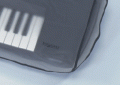
Classenti Dust Cover – Picture shows
the cover‘s bottom right corner
This cover fits over the top of you piano (keys
and top wooden panel). You’ll have to fold
down the music rest though. If your piano
has its own key cover, it will fit over that too.
It’s made from a high quality vinyl sheet. This
type of material stops most liquids from
penetrating your piano’s keyboard.
You can find out more about these dust covers
by clicking this link:
To summarise, these covers are:
- Waterproof (stops liquids from destroying
your piano) - Hard wearing (protects your instrument
and prolongs its life) - Anti-static (helps prevent electrical fires)
- Transparent (you can see if you’ve left
your piano switched on)
To see which covers fit a specific piano model,
click here.
(g) Are wooden mechanisms in digital pianos a
good thing, or could they be a risky purchase?
Some top of the range digital pianos now come with
wooden mechanisms.
But I have my doubts about this.
Wooden mechanisms in digital pianos do look like,
and perform in a similar way to, a real acoustic piano
mechanism…
But, I’m concerned that having a wooded mechanism
in a digital piano could cause problems later…
For instance, digital pianos are known to withstand
heat sources a lot better than acoustic pianos. This
is because there ISN’T wood inside the piano…
Adding wood to the mechanism and keys could
create problems of loose or sticky notes.
What’s more, I see it as a risky purchase…
If digital piano manufacturers decide that it really
wasn’t such a great idea to put wood inside a
digital piano, they will revert to plastic and metal
mechanisms…
This could cause a mass shortage of spare parts
for those that own digital pianos with wooden
mechanisms…
Although there are no reported instances of this,
it could be something to think about…
(h) Are warranties transferable on digital pianos?
This is quite a common question. But it usually
only crops up when someone is about to buy (or
has just bought) a second hand digital piano
from a private seller.
A typical scenario is when the seller tells the
prospective buyer that there’s still one or two
years left to run on the warranty. So the buyer
thinks he has a guarantee and is covered for
future repairs.
Unfortunately, this is not correct…
Digital piano warranties are NOT transferable to
a new owner. The warranty remains with the
original owner.
Of course, this is not usually the case when you
buy a second hand piano from a shop. Although
the warranty is still not transferable, you do get
the shop’s own warranty. This usually covers
parts and labour for one year (sometimes two).
By all means look around for a second hand
bargain on the internet. But just be aware that
digital pianos aren’t covered by a warranty when
you buy from a private seller.
If you would prefer to have the peace of mind a
warranty provides then I recommend buying from
an internet store or retail shop (choose from my
list of recommended stores in section 7b).
But, check what type of warranty you’ll be getting
(parts and labour; parts only; fix-at-home;
return to store?) and how long it’s for. The best
type of warranty is always ‘In-Home with parts
and labour included’.
Here are some second hand pianos for sale:
Click here >> https://www.ukpianos.co.uk/used-digital-pianos
(i) What’s the average life of a digital piano?
Digital pianos have an average life of 10 years.
Now, this figure depends on the following:
1) Quality of the piano’s parts (especially the
keyboard and electronics)
2) How much it is played
3) How it is looked after
The worst case scenario is:
A cheap, poor quality, unknown Chinese digital
piano that’s hammered for 2 hours a day, and
kept in a really dusty or dirty place, can last
only 2 or 3 years.
The best case scenario is:
A high quality (and high price) digital piano
from a leading brand, that doesn’t get played
every day, and is kept in a clean and tidy
environment could last for up to 20 years.
Useful Links:
Bags and Cases
https://www.ukpianos.co.uk/gig-bags-and-cases-for-piano-and-keyboard
Dust covers
https://www.ukpianos.co.uk/dust-covers
Piano Stools
https://www.ukpianos.co.uk/piano-stools-and-keyboard-benches
Headphones
https://www.ukpianos.co.uk/keyboard-piano-headphones
3) The Disadvantages of Buying a Second Hand
Digital Piano, Versus a New One
No guarantee
Unless you’re buying from a shop, it’s highly
unlikely you’ll get any guarantee with a second
hand piano.
New pianos come with a warranty from anywhere
between 1 and 10 years. The length of the
warranty depends on the make, and of course,
where you buy it from.
No returns policy
Buying from a private seller doesn’t give you
the same legal rights you’d get if you bought
from a shop.
If you buy a second hand digital piano then I
definitely advise buying from either a physical
shop, or a reputable online retailer. This is
because by law you get 7 working days to
change your mind. Some shops offer you 14,
or even 30 days.
If you do decide to buy from a private seller
then make sure you get the piano thoroughly
checked out before you commit (section 4 of
this report will give you many tips on how
you can do this yourself).
** Please don’t take this advice lightly**
It’s extremely unlikely you’ll get any
guarantee or comeback if you buy from a
private seller, whether it be through an online
auction, marketplace, local newspaper, or by
any other means.
Old technology
Second hand digital pianos have old technology.
Depending on the age of the piano you may get
technology that’s out-dated such as: CD drive,
smart media, floppy disk drive, etc.
Digital pianos are always improving
Second hand digital pianos often have a less
realistic touch (inferior key mechanisms)
than the latest models…
The sound quality can also be less realistic.
This is because new methods of sound
sampling are often superior.
Cabinet styles and designs can be dated
Older cabinet styles are usually bigger or
chunkier than current ones. This means they
take up more space in your home.
Can be damaged when shipping
Unless you plan on picking up the piano
yourself, then it’s not wise to let a private
seller arrange deliver of your piano by courier…
A second hand piano can get damaged if you
allow it to be delivered by a courier company…
This is because it’s almost impossible to pack
it securely enough (unless it’s in its original
packaging) – highly unlikely if it’s a second
hand piano.
You’d be best off collecting the piano yourself,
or asking them to deliver it personally.
Very difficult to make a claim
Buying a second hand digital piano from a
reputable piano shop is your best bet…
All pianos delivered by a shop are fully
insured. So if anything were to happen,
you would get your money back.
Might be in need of repair
Repairs on second hand digital pianos can cost
you a fortune. Even something as simple as a
single note not sounding could cost upwards
of £150 to get fixed! That’s assuming parts
are still available.
Parts may be hard to get
Manufacturers don’t always keep parts for
older models…
So, if you have a piano that’s more than 5 years
old, you could find yourself in a situation where
it’s difficult to get hold of parts.
If parts are not available, then a good digital
piano technician should be able to fix your
piano in most cases…
But this takes a lot longer than simply replacing
a part. Technicians charge by the hour (usually
from £60 to £100 per hour).
So watch out!
Usually no user manual
If you’re lucky, you’ll get a user manual with a
second hand digital piano. Otherwise you may
have to spend hours online trying to find out
how to use some of its functions.
There really is only one advantage of buying a
second hand digital piano over a new one – the
price, of course…
But…
You may be pleasantly surprised at how much a
decent new digital piano costs these days. Not
only has technology advanced, but prices have
held, and in some cases, reduced over a long
period.
For example: I bought a very basic Yamaha
Clavinova in 1989. I paid about £1,000 for it.
Today you can buy the equivalent model
for around the same price!
Here’s what I advise…
If you really must buy a second hand digital
piano then get something that’s no more than
3 years old. You’ll save a little money, and,
hopefully, you’ll get something that has
current technology.
Where to buy from?
Check out the complete range of second hand
digital pianos available from ukpianos.co.uk:
https://www.ukpianos.co.uk/used-digital-pianos
4) 6 Simple Tests You Can Do In A Piano Store
Before Making Your Decision. DON’T BUY If
The Piano Doesn’t Pass All 6!
(a) Stand at a distance and get someone to play
This is usually the best way to tell if the piano
sounds good, or not.
By standing a short distance away from the piano
while someone else is playing makes it easier for
you to concentrate on the piano’s sound.
(b) Turn the volume off, or right down. Are
the keys noisy or clicky?
A frequent complaint about digital pianos is
the noise of the keys…
Key noise is not so noticeable when you play
the piano with the volume turned up.
The best way to test this is to turn the volume
down or off. Then press down the keys. You
should be able to hear a dull thud when the key
goes down and a soft plop when the key returns.
There are many different digital piano brands and
models. Each one makes some degree of noise
from the keys.
The best piano mechanisms make a soft, dull
thud when the keys go down, and a very
light thud or a delicate plop on return.
The worst mechanisms make a loud, clicking
thud when the keys go down, and sometimes
an equally loud, rattling noise on return.
Another test is to play the key hard, and flick
the finger away so it returns quickly. A poor
mechanism will make a loud, clicking noise.
(c) Do the keys move a lot from side to side?
Wiggle a key from side to side with your thumb
and index finger. Then press the key down to
the very bottom and wiggle in the same way.
Firstly, there should be a small amount of
movement from side to side. The key shouldn’t
touch the adjacent white or black key.
Secondly, there should be no clicking or
tapping noises.
If you do hear excessive noise, then there’s
probably too much sideways movements on
the keys…
This sideways movement results in a loose,
wobbly feel when you’re playing.
And that’s not a nice feeling!
You should also check the spacing between
white keys. The gaps should be the same.
A sign of good quality is level keys with
the same spacing and smooth key edges.
(d) Are the keys touch sensitive?
Don’t buy a digital piano that doesn‘t have
touch sensitive keys!
I can’t stress this enough.
How can you tell the number of touch
sensitivity levels on a digital piano?
There are 3 ways:
(i) You can ask the salesperson (but they
may not know)
(ii) You can try and work it out for yourself.
It’s not easy to distinguish the different touch
sensitivity levels, especially if you’re not an
experienced player.
Here’s the best way to do it:
Press the key down as slowly as you can until
you hear a sound. This is touch sensitivity
level 1.
Next, play it with a little more speed. If the
sound is louder then you’ve found touch
sensitivity level 2.
Keep going until you don’t notice any difference
in volume, no matter how much harder you press
down the key.
(iii) You can refer to my article: ‘Digital Pianos –
Which Brand Should You Buy?’ This article
gives the touch sensitivity levels for the most
popular digital pianos.
Click on the link below to get it:
https://www.ukpianos.co.uk/digital-pianos-which-brand-should-i-buy
Note: Most budget digital pianos have three levels
of touch sensitivity. More advanced pianos have
four levels. And the best pianos have five levels.
If you’d like to know how many levels a particular
piano has then email me: grahamhoward@ukpianos.co.uk
(e) How much weight is on the keys?
When you press down the key you should feel
some resistance.
You should also feel some resistance when the
key returns, but not as much.
Many of the cheaper key mechanisms feel false.
The weighting is un-natural. It can have a
light touch, but feel heavy at the same time…
Let me explain:
Poor quality key mechanisms can have very
bouncy keys. It can take little effort to push
down the key, but you can feel quite a strong
‘springy’ type of resistance under your finger
when the key returns.
Because of this strong, spring-like action, the
key also returns very quickly.
Ideally you want your piano to have fairly heavy
weighted keys. This will strengthen your finger
muscles making the transition to a real piano
much easier.
The ideal key weight is heavy, but evenly heavy
on the way down and slightly less heavy on the
key’s return.
You shouldn’t feel that the key is pushing your
finger up too strongly on its return.
You can get a feel for it by playing middle C
slowly, up and down, several times with your
index finger, on every digital piano in the shop.
If you do this enough times, you’ll discover
which pianos have the better key touch…
The salesperson might also think you’re an expert 😉
(f) How long does the sound sustain?
A good upright piano has the power to sustain
a note in the centre of the piano for around 15
to 20 seconds.
Ideally you want the same with a digital piano.
After all, a digital piano is supposed to replicate
a real one.
In reality, the sustaining power of most digital
pianos is between 6 and 15 seconds.
The best way to test the power of a digital
piano’s sustain is to play middle C as hard as
you can and hold it down.
The note should gradually die away to nothing.
If the note cuts off in less than 10 seconds,
don’t buy it!
Note: When you are doing the sustain test, the
volume should be on half way.
Useful Links:
https://www.ukpianos.co.uk/digital-pianos-which-brand-should-i-buy
https://www.ukpianos.co.uk/digital-piano-questions
5) The only COMPLETE List of Digital Piano
Brands. And The Top Digital Piano Brands
Scored On:
(a) Selection (top 5 brands)
(b) Reliability (top 10 brands)
(c) Long term popularity (top 5 brands)
(d) Recent popularity (top 5 brands)
(e) Overall result (top 15 brands)
Here‘s the list of all digital piano brands:
Adagio (sold by Costco Canada -not available in the UK)
Alesis
Andante (sold only in Northern Ireland)
Artesia
Astiar (sold mainly in China)
Aura (made by Kaino – not available in the UK)
Axus (sold only in the UK)
Amadeus (sold only in Holland)
Amason (sold only in China)
Ashton
Baldwin (sold only in China)
Behringer
Bellissimo
Benjamin Adams (sold only in the US)
Bentley
Berkeley (sold only in the UK)
Bestman (sold only in China)
Bluthner
Broadway (sold only in the UK)
Cameron (sold only in the US)
Carlsbro
Casio
Chase
Classenti (sold worldwide)
Classic Cantabile (not available in the UK)
Cool
Cranes
Crawzer (made by KDY – sold only in China)
Cristofori (made by Sejung – sold only in Asia)
Crumar
Delson
Digiano (sold only in the UK)
Dixibell
Donner
Dorimei
Duoliemi
Dynatone (sold throughout Europe and the US)
Eagletone
Ensoniq
Entrada (sold only in Holland)
Fame
Farfisa (not available in the UK)
Fazley
Feeling (sold mainly in China)
Fesley
Fujiyama (sold only in Canada)
Galileo (not available in the UK)
Gear4Music (sold only in the UK)
Gewa (sold worldwide)
Glarry
Greaten (sold in China, Korea, Canada and Holland)
Hadley (sold only in the UK)
Hafnia
Hailai (made by Huangma – sold mainly in China)
Hammond (only stage pianos available in the UK)
Harmony (made by KDY – sold mainly in China)
Hemingway (sold in UK and Europe)
Hongye (sold mainly in China)
HStar (a.k.a. Brahner Hstar)
Huangma (sold mainly in China)
Ingale (sold mainly in China)
Kaino
Kawai (sold worldwide)
Kazen (sold mainly in China)
KDY (sold mainly in China)
Ketron (only stage pianos available in the UK)
Keywood
Kingston (sold by Costco Canada – not available in the UK)
Kobrat (sold only in Spain)
Kohler
Korg (sold worldwide)
Kurzweil (sold worldwide)
Laite (sold mainly in China)
Lalaho
M-Audio (only stage pianos available in the UK)
Mantova (sold only in the UK)
Medeli (sold mainly in China)
Melodic (sold mainly in Australia)
Minster (sold only in the UK)
Moco (sold only in Iran)
Montford
Mustar
Nord (stage pianos, organs, midi controllers and sythns)
NUX
Orange (sold only in Canada)
Orla
Pianonova (not available in the UK)
Regent
Rikter
Ringway (sold in China, Spain and New Zealand)
Roland (sold worldwide)
Roth and Junius
Samick (not available in the UK)
Sejung (not available in the UK)
Shijue (made by Huangma – sold mainly in China)
Sonic (sold mainly in china)
Silbermann
Smallbrook (sold only in the UK)
Steinbeck (sold only in Holland)
Steinfort (sold only in Holland)
Studiologic (stage pianos, midi controllers and sythns)
Sulinda (sold only in the UK)
Suzuki (sold worldwide)
Symphonia
Tangoo (sold mainly in China)
Thomann (sold in UK and Europe)
Oostendorp (sold only in the Netherlands)
Ousman (sold mainly in China)
Valdesta (only available in the US)
Viscount
Wertheim (only available in Australia)
Williams (available in the US and Denmark)
Worlde (sold mainly in China)
Wsman (sold mainly in China)
Wyman
Yamaha (sold worldwide)
Young Chang (sold mainly in China)
Total: 120 brands
And here’s a list of companies that have stopped
making digital pianos:
Akai (discontinued producing digital pianos)
Bohemia (discontinued producing digital pianos)
Bohm (discontinued producing digital pianos)
Daewoo (discontinued producing digital pianos)
Diginova (discontinued producing digital pianos in March 2015)
Gem (went out of business in 2009)
Robertson (discontinued producing digital pianos in March 2013)
Solton (discontinued producing digital pianos)
Stagg (discontinued producing digital pianos)
Technics (discontinued producing digital pianos)
Wersi (discontinued producing digital pianos)
Winchester (discontinued producing digital pianos in 2014)
(a) The top 6 digital piano brands based on:
SELECTION
Too much choice can be confusing for some. And
not enough choice can be a problem for others.
Buying a digital piano is something you don’t
do very often. So getting it right the first time
is VERY important.
Touch and sound are the most important
aspects of the piano to get right. This shouldn’t
be compromised no matter what.
After that, you’ll likely want to find a piano
that’s the right size, style, weight, and colour.
You’ll probably have to make some compromises,
but the more selection you have to choose from,
the more likely you’ll find something that suits
most of your needs.
Here’s a list of the top 5 brands, starting with
the brand that has the largest selection of
models and colours first:
1st place: Yamaha
Clavinova range: CLP (5 models and 1 grand),
and CVP (3 models and 1 grand)
CSP (2 models)
Arius and YDP budget range: (4 models)
DGX range: (1 model)
Piaggero range: (4 models)
P series portable range: (1 model)
CP series portable range (3 models)
Avantgrand (4 models)
Total: 29 different pianos with a varied range
of colours.
Notes: Yamaha digital pianos have been
amongst the best for a long time. This is
due to Yamaha’s marketing skills; wide
choice of models; history as a brand; and
their close resemblance to acoustic pianos.
2nd place: Kurzweil
M range (3 models)
MP range (3 models)
MPS portable pianos (2 models)
CUP range (6 models)
MPG grand pianos (2 model)
CGP grand pianos (1 model)
KA portable pianos (4 models)
KAG grand piano (1 model)
SP portable pianos (3 models)
SPS portable pianos (1 model)
Artis portable piano (1 model)
Forte portable piano (1 model)
Total: 28 different pianos with a good range
of colours.
Notes: Kurzweil offer a vast range of digital pianos
for the home, portable/stage pianos and controller
keyboards. Kurzweil are famous for their authentic,
natural piano sound. And some of their models use
the famous Fatar, Italian made key action and Italian-
made wooden key actions in their top models.
3rd place: Roland
GoPiano (1 model)
RP range: (1 model)
HP range: (3 models)
HPi range: (1 model)
FP portable pianos: (2 models)
RD and V portable pianos: (3 models)
DP and F compact range: (3 models)
RG grand pianos: (2 models)
LX range: (2 models)
Total: 18 different pianos with a good range
of colours.
Notes: With Roland digital pianos you get
a realistic sound and very good reliability.
But you’ll find them pricier than equivalent
models from other brands.
4th place: Kawai
CN range: (2 models)
CA range: (3 models)
CL compact range: (2 models)
CS range: (3 models)
MP and ES portable pianos: (3 models)
KDP range: (1 model)
KCP range: (1 model)
Total: 15 different pianos with a good range
of colours.
Notes: Kawai are a relatively new comer to
digital pianos. They offer a good selection of
different models to suit beginners up to
advanced pianists.
More often than not you’ll discover that Kawai
are the pianos that most shops ‘recommend’ (push).
Kawai make nice digital pianos, especially their
top of the range models (£2,000+).
But the main reason shops ‘recommend’ Kawai
is because they make more money than they
would by selling other brands.
Beware of piano shops that appear to be pushing
Kawai. They might have only their own interest
at heart.
5th place: Casio
Privia range: PX (6 models)
Celviano range: AP (5 models)
Hybrid range: GP (3 models)
CDP budget range: (1 model)
Total: 14 different pianos with a very limited
range of colours.
Notes: Casio digital pianos are aimed at the
lower end of the digital piano market.
Their build quality is OK (but could be improved),
their sound a little thin, and their touch not as
realistic as the big four: Yamaha, Roland, Kawai,
and Kurzweil.
Why would anyone buy a Casio then?
You might buy a Casio if:
1) Your budget is REALLY tight, and it’s all you
can afford. So a really cheap, second hand Casio
might do the job for a year, or maybe two, but
certainly no longer than that.
Please note: there are many makes of digital
pianos out there that aren’t as good as Casio.
So you could do a lot worse.
2) You only have space for a slim line digital
piano. The Privia range fits the bill.
Casio offer 2 piano ranges: Celviano and Privia.
Celviano pianos start with the letters AP. Casio’s
AP range are multi-functional pianos. This means
they’re loaded with ‘gadgets’: instrumental voices,
internal songs, etc. They’re a bit over priced for
the quality you get really.
Casio’s Privia range are budget pianos that are
suitable if you have limited space. Although
they have the advantage of being compact, the
sound and touch is inferior to the big four brands.
But for the price, the Privia range is really good
value for money. They’re much better than most
Chinese budget models.
6th place: Gewa
PP range: (1 models)
CP range: (1 model)
DP range: (2 models)
UP range: (1 model)
Total: 5 different pianos with a range
of colours.
Notes: What I like most about the Gewa pianos
are their natural, clean piano tone. They’re sampled
on a Steinway concert grand in Hamburg… and you
can hear the warm, full, rounded tone throughout.
What’s more, the UP540 has 5 dynamic levels,
which allows you to put the full expression into
your music without limitation.
You can play the quietest pianissimo to a full fortissimo.
(b) The top 10 digital piano brands
scored on RELIABILITY:
How reliable are digital pianos?
Most digital pianos are either made or assembled
in the Far East (China and Indonesia in particular).
The assembly and quality control processes in
Far Eastern factories play a MAJOR factor in
your piano’s overall reliability.
The quality of materials used in producing digital
pianos varies widely from one brand to the next.
You can be sure that many corners are being cut
to produce most of the very cheap digital pianos
(mostly those under £500).
Summary
Assembling, quality control and selection of
materials affect your piano’s overall performance,
reliability, and, ultimately, the life of your piano.
Taking everything into consideration, here’s
my list of the top ten most reliable piano makes.
I’ve based this on:
(i) Who manufacturers them
(ii) The standard of the factory they’re made in
(iii) Quality of materials used (including build quality)
(iv) The factory’s quality control procedure
(v) Percentage of warranty claims
(vi) Average life of the piano
Here are the top ten most reliable pianos:
1st place: Roland (83 out of 100)
2nd place: Yamaha (83 out of 100)
3rd place: Gewa (82 out of 100)
4th place: Broadway (78 out of 100)
5th place: Kawai (76 out of 100)
6th place: Casio (72 out of 100)
7th place: Kurzweil (68 out of 100)
8th place: Hadley (68 out of 100)
9th place: Classenti (67 out of 100)
10th place: Korg (64 out of 100)
Notes:
11th, 12th and 13th place are very close between
many digital piano brands. So here are
the ones that narrowly missed the top 10:
Thomann (55 out of 100)
Gear4Music (54 out of 100)
Hemingway (51 out of 100)
Suzuki (49 out of 100)
Yamaha, Roland, Kurzweil, Gewa, Kawai, Casio
and Korg manufacture their own pianos…
These manufacturers rely on physical shops to
sell them in their stores and on the internet.
Thomann pianos can only be found on the
Thomann website. Their pianos are produced
in a factory that also manufacturers for other
brands.
Important note: you shouldn’t choose your
piano just because it rates high in reliability…
An authentic touch and realistic sound is much
more important.
(c) The top 5 digital piano brands
scored on LONG TERM POPULARITY:
Before the year 2000 there were only a handful
of digital piano makers. Today there’s over 30
and counting…
Yamaha, Roland and Kurzweil have been producing
digital pianos for the longest.
Kurzweil were the first company to successfully
emulate the sound of a grand piano in a digital
instrument in 1982.
Yamaha introduced its first digital piano in
1983: the YP-40. The first Roland was in 1986:
the RD-100. Other manufacturers entered the
market much later.
The first digital pianos to be manufactured in
China was in 1999.
Although you shouldn’t base your buying
decision entirely on how long a manufacturer
has been producing pianos, it does give you a
little extra confidence…
It may also add a little to its resale value.
Here’s my top five (in order of the most
popular in the long term, first)
1st place: Yamaha digital pianos
Yamaha have been producing digital pianos for
the longest. They’ve held the number one
position from day one. And they are the
most popular long term.
2nd place: Roland digital pianos
Since Roland introduced their first digital
piano they’ve been trying to catch up with
Yamaha. And they’ve been doing a good job
of it. In fact, sometimes Yamaha are having
to play catch up with them when it comes
to designing new features.
3rd place: Kurzweil digital pianos
Kurzweil stage pianos, synthesizers and
keyboards are popular worldwide. Their home
digital pianos are better known in the United
States and Eastern Europe than they are in
the UK and Western Europe. This is because
they only became available in the UK about
6 years ago.
Kurzweil offer a nice range of digital pianos
both for the home and stage.
If you want an authentic piano tone, then
Kurzweil are difficult to beat.
4th place: Casio digital pianos
Casio are more famous for their electronic
keyboards than they are for their pianos.
But they do offer a good variety of pianos.
From the year 2003-2006 they expanded their
range of pianos quite considerably…
Casio used to offer a comprehensive range of
digital pianos including: portable, multi-
functional, compact, and key lighting pianos.
Included in their line-up were the extremely
popular PS-20, and the first, ultra-compact
piano, the PX100, from their Privia range.
In recent years they’ve reduced their selection
to the Privia range, the Celviano and a couple
of budget model pianos.
5th place: Kawai digital pianos
Kawai have been making acoustic pianos for
many years. But they’ve fairly new to the
digital piano arena.
The first Kawai digital piano I played on was
in the year 2002. It had a very bright, harsh
sound. And the touch was poor.
But they’ve improved since then.
Kawai have a big range of digital pianos to
choose from. So they’ve worth considering if
you’re looking for a specific style.
(d) The top 5 digital piano brands
scored on RECENT POPULARITY:
By recent, I mean in the last 1-2 years.
All day long I get phone calls and emails with
questions about digital pianos.
I’m not complaining… I enjoy it!
So I get a good feel for which pianos people ask
about the most. This is the surest gauge for
which pianos are the most popular right now.
Here’s a list in order of ‘asked about most’ first.
1st place: Yamaha digital pianos
Most popular models asked about: YDP164
P45, CLP725 and CLP745
2nd place: Roland digital pianos
Most popular models asked about:
F-140R, FP-30, RP-102, HP702, HP704
3rd place: Casio digital pianos
Most popular models asked about:
CDP130, PX160, PX360 and AP270
4th place: Kurzweil digital pianos
Most popular models asked about:
MP120, M110, MPS10, CUP320, MPG100
5th place: Kawai digital pianos
Most popular models asked about:
CN27, CN37, CL37 and CA67
(e) The top 18 digital piano brands
OVERALL RESULT:
Taking all of the above into consideration,
here is the top 18 digital piano makes:
1st place: Yamaha
2nd place: Roland
3rd place: Kawai
4th place: Gewa
5th place: Broadway
6th place: Casio
7th place: Korg
8th place: Hadley
9th place: Kurzweil
10th place: Classenti
11th place: Bluthner
12th place: Galileo (not available in the UK)
13th place: Gear4Music
14th place: Thomann
15th place: Orla
16th place: Suzuki
17th place: Hemingway
18th place: Chase
Further Reading:
If you’ve been overwhelmed with information
then you can read my simplified article:
Digital Pianos – which Brand Should You Buy
This article also gives independent scores for
each brand on: Touch, sound, design, build quality,
reliability, resale value, recent popularity, value
for money, and an overall rating.
To read the article click here.
Important note: To follow any link in this guide you must
hover over the link, press the ctrl key then click on the link.
6) Which Best Digital Pianos Are The Best?
(a) The top ten list of piano models.
Rated on a combination of touch, sound,
design, build quality, reliability, resale
value, popularity, and value for money
*Important Note*
This is an overall score on all attributes listed
above. You might find that a particular piano
scores higher or lower in this list than in other
lists. This is because both resale value and
popularity is taken into consideration…
For example: Just because a piano is popular
or has better resale value doesn’t make it
sound or feel any better to play. Nor does it
improve its reliability.
A digital piano should sound and feel as close
to a real piano as possible. You would also
expect it to be resilient and reliable.
The two most important aspects of the piano
are the touch and sound. You should look extra
carefully at the pianos that score the highest in
both these categories.
The ‘value for money’ score I’ve given for each
piano is also important.
Note: If you’d like to know the individual
scores for all digital pianos then check the
piano rating system The Howard Score.
Here is my top ten list:
1st place: Yamaha CLP845
Touch: 9.25
Sound: 9.2
Design: 8.25
Build Quality: 8
Reliability: 8
Re-sale Value: 6.5
Popularity: 7.6
Value for money: 7
Overall rating: 63.85 out of 80
Questions and Answers
Click here: https://www.ukpianos.co.uk/yamaha-digital-piano-questions
2nd place: Gewa UP540
Touch: 8.9
Sound: 9
Design: 8.5
Build Quality: 8.5
Reliability: 8.7
Re-sale Value: 5
Popularity: 4
Value for money: 9
Overall rating: 61.6 out of 80
Useful Links For UP540:
Lowest Prices, Information and Specifications
Click here: https://www.ukpianos.co.uk/gewa-up540
3rd place: Broadway BW1
Touch: 8
Sound: 8.2
Design: 8.5
Build Quality: 8
Reliability: 8
Re-sale Value: 6.5
Popularity: 7
Value for money: 9
Overall rating: 63.2 out of 80
Useful Links For BW1:
Lowest Prices, Information and Specifications
Click here: https://www.ukpianos.co.uk/broadway-bw1
4th place: Gewa DP520
Touch: 7.9
Sound: 8
Design: 7.5
Build Quality: 8
Reliability: 8.5
Re-sale Value: 5
Popularity: 6
Value for money: 9
Overall rating: 59.9 out of 80
Useful Links For DP520:
Lowest Prices, Information and Specifications
Click here: https://www.ukpianos.co.uk/gewa-dp520
5th place: Roland HP704
Touch: 8.5
Sound: 8.5
Design: 8
Build Quality: 8.4
Reliability: 8
Re-sale Value: 5.5
Popularity: 6
Value for money: 7
Overall rating: 59.9 out of 80
6th place: Kurzweil MP120
Touch: 8
Sound: 8.8
Design: 8
Build Quality: 7.5
Reliability: 7
Re-sale Value: 5.75
Popularity: 5
Value for money: 8.8
Overall rating: 58.85 out of 80
Useful Links For MP120:
Lowest Prices, Information and Specifications
Click here: https://www.ukpianos.co.uk/kurzweil-mp120
7th place: Roland RP701
Touch: 7.5
Sound: 8.1
Design: 8
Build Quality: 7.5
Reliability: 8
Re-sale Value: 6.5
Popularity: 6
Value for money: 7
Overall rating: 58.6 out of 80
Questions and Answers
Click here: https://www.ukpianos.co.uk/roland-piano-questions
8th place: Yamaha CLP825
Touch: 8.1
Sound: 8.15
Design: 7
Build Quality: 7.5
Reliability: 7.5
Re-sale Value: 7.25
Popularity: 7
Value for money: 6
Overall rating: 58.5 out of 80
Useful Links For CLP725:
Questions and Answers
Click here: https://www.ukpianos.co.uk/yamaha-digital-piano-questions
9th place: Kurzweil M110
Touch: 7.4
Sound: 8.2
Design: 8
Build Quality: 7.5
Reliability: 7
Re-sale Value: 6
Popularity: 5.5
Value for money: 8.9
Overall rating: 58.5 out of 80
Useful Links For M110:
Lowest Prices, Information and Specifications
Click here: https://www.ukpianos.co.uk/kurzweil-m110
10th place: Hadley D10
Touch: 7
Sound: 6.6
Design: 7
Build Quality: 7.5
Reliability: 7.25
Re-sale Value: 6.5
Popularity: 6.5
Value for money: 9.5
Overall rating: 57.85 out of 80
Useful Links For D10:
Lowest Prices, Information and Specifications
Click here: https://www.ukpianos.co.uk/hadley-d10
More places you can read reviews:
https://www.pianoreviews.org
https://www.piano-tuners.org
>> Find out how all digital pianos rate in the Howard Score
https://www.ukpianos.co.uk/the-howard-score
If you’d like advice on a particular model that’s
not mentioned in this book then drop mean
email: grahamhoward@ukpianos.co.uk
(b) The top ten list of piano models in each
of four categories: the best under £500,
the best from £500 to £800, the best from
£800 to £1200, and the best over £1200
Please note: The prices in this section have been
taken from the internet. If you buy from a physical
shop then you might pay considerably more.
It’s difficult to know how much to spend on
your first piano. Especially if it’s for your
children to learn on… you just don’t know
how long they’re going to stick with it.
Should you buy something cheap until you
are sure you’ll continue with it?
Or, should you buy a top-of-the-range model
so you won’t need to upgrade later?
Well…
You shouldn’t buy the cheapest piano you can
find. This is because it will have a poor sound
and unrealistic touch. It’s also more likely to
be unreliable.
Likewise, you shouldn’t spend too much until
you are sure that playing the piano is for you.
Here are the negatives of buying a CHEAP
digital piano:
(a) You’ll find it much more difficult to learn on
a piano that performs poorly.
(b) You’ll find it difficult to transfer to an upright
or grand piano if you’ve been used to playing on
a digital piano with a poor, un-responsive touch.
(c) You could find yourself spending a small
fortune to get it repaired after the guarantee
has expired.
(d) The lifespan of the piano will be less than a
better quality one.
(e) You’ll be more likely to give up playing if
you’ve been struggling on a poor performing
piano.
Here are the negatives of buying an
EXPENSIVE digital piano:
(a) If you give up playing then you’ll probably
regret you spent so much money.
(b) The main reasons some digital pianos cost
more than others is because you get additional
voices, rhythms, percussion sounds, effects and
gadgets. Most of these you’ll probably never use.
I advise getting something between £600 and
£1,200. The nearer you can get to £1,200 the
better it will perform for you in the long term.
Don’t worry if you can’t afford a piano above £600.
There’s still some choice around this price point.
There’s also a ‘Rent-To-Own’ programme…
‘Rent-To-Own’ gets you a better piano for a small
monthly outlay, without commitment (usually
around £40 to £55). Your monthly payments are
also deducted from the price when you purchase.
For more information click here:
https://www.ukpianos.co.uk/piano-rental
It’s also OK to spend over £1,200 if there’s a piano
you’ve fallen in love with! Maybe you really will
use some of those gadgets.
So, keeping in mind that you may not be buying
a piano in the ideal £600 to £1,200 price, here’s
my list of the top 10 pianos under £500 (internet
prices):
Note: The following lists rate each piano on: touch,
sound, design, build quality, reliability and value
for money. Re-sale value and popularity aren’t
taken into consideration because they don’t affect
the piano’s performance.
1) Top Ten Under £700 (internet prices):
1st place: Hadley D10 (£600 – £700)
Click link below for info and best prices
https://www.ukpianos.co.uk/hadley-d10
2nd place: Broadway AB1 (under £600)
Click link below for info and best prices
https://www.ukpianos.co.uk/broadway-ab1
3rd place: Casio PX160 (£500 – £600)
Click link below for info and best prices
https://www.ukpianos.co.uk/casio-px160
4th place: Yamaha P45 (about £550)
Click link below for info and best prices
https://www.ukpianos.co.uk/yamaha-p45
5th place: Hadley S1 (under £600)
Click link below for info and best prices
https://www.ukpianos.co.uk/hadley-S1
6th place: Korg B1 (under £550)
Click link below for info and best prices
https://www.ukpianos.co.uk/korg-b1
7th place: Casio CDP130 (under £500)
Click link below for info and best prices
https://www.ukpianos.co.uk/casio-cdp130
>> Find out how digital pianos rate in the Howard Score
(Get FREE piano advice by calling 020 8367 5107)
Note: The following lists rate each piano on: touch,
sound, design, build quality, reliability and value
for money. Re-sale value and popularity aren’t
taken into consideration because they don’t affect
the piano’s performance.
2) Top Ten £700 – £1000 (internet prices):
Note: The following list rates each piano on
a combination of touch, sound, design, build
quality, reliability and value for money.
1st place: Broadway BW1 (under £1000)
Click link below for info and best prices
https://www.ukpianos.co.uk/broadway-bw1
2nd place: Broadway EZ-102 (under £800)
Click link below for info and best prices
https://www.ukpianos.co.uk/broadway-ez-102
3rd place: Kurzweil MPS10 (under £800)
Click link below for info and best prices
https://www.ukpianos.co.uk/kurzweil-mps10
4th place: Casio AP270 (£600 – £700)
Click link below for info and best prices
https://www.ukpianos.co.uk/casio-ap270
5th place: Hadley D20 (under £800)
Click link below for info and best prices
https://www.ukpianos.co.uk/hadley-d20
6th place: Yamaha YDP145 (under £900)
Click link below for info and best prices
https://www.ukpianos.co.uk/yamaha-ydp145
7th place: Yamaha DGX660 (about £800)
Click link below for info and best prices
https://www.ukpianos.co.uk/yamaha-dgx660
8th place: Casio PX360 (£700 – £750)
Click link below for info and best prices
https://www.ukpianos.co.uk/casio-px360
9th place: Roland FP-30 (£550 – £650)
Click link below for info and best prices
https://www.ukpianos.co.uk/roland-fp30
11th place: Yamaha P125 (under £700)
Click link below for info and best prices
https://www.ukpianos.co.uk/yamaha-p125
>> Find out how all digital pianos rate in the Howard Score
https://www.ukpianos.co.uk/the-howard-score
(Get free piano advice by calling 020 8367 5107
3) Top Ten £800-£1,200 (internet prices):
Note: The following list rates each piano on
a combination of touch, sound, design, build
quality, reliability and value for money.
1st place: Broadway BW1 (under £1000)
Click link below for info and best prices
https://www.ukpianos.co.uk/broadway-bw1
2nd place: Gewa DP520 (under £1000)
Click link below for info and best prices
https://www.ukpianos.co.uk/gewa-dp520
3rd place: Gewa DP345 (under £1400)
Click link below for info and best prices
https://www.ukpianos.co.uk/gewa-dp345
4th place: Roland RP701 (under £1200)
Click link below for info and best prices
https://www.ukpianos.co.uk/roland-rp301
5th place: Yamaha YDP165 (£1000 – £1100)
Click link below for info and best prices
https://www.ukpianos.co.uk/yamaha-ydp165
6th place: Roland F-140R (£900 – £1000)
Click link below for info and best prices
https://www.ukpianos.co.uk/roland-f-140r
7th place: Broadway B3 (£950 – £1000)
Click link below for info and best prices
https://www.ukpianos.co.uk/broadway-b3
8th place: Yamaha YDP-S34 about £1000)
Click link below for info and best prices
https://www.ukpianos.co.uk/yamaha-ydp-S34
9th place: Casio AP670 (£900 – £100)
Click link below for info and best prices
https://www.ukpianos.co.uk/casio-ap670
10th place: Casio PX870 (£750 – £800)
Click link below for info and best prices
https://www.ukpianos.co.uk/casio-px870
4) Top Twenty Over £1,200 (internet prices):
Excludes grand pianos, stage pianos and Yamaha AvantGrand:
Note: The following list rates each piano on
a combination of touch, sound, design, build
quality, reliability and value for money.
1st place: Yamaha CLP785 (£3,500 – £4,000)
Click link below for info and best prices
Yamaha CLP785 (ukpianos.co.uk)
2nd place: Gewa UP540 (under £1700)
Click link below for info and best prices
https://www.ukpianos.co.uk/gewa-up540
3rd place: Gewa UP395 (under £2000)
Click link below for info and best prices
https://www.ukpianos.co.uk/gewa-up395
4th place: Roland HP704 (£1,800 – £2,000)
Click link below for info and best prices
https://www.ukpianos.co.uk/roland-hp704
5th place: Yamaha CLP875 (£2,500 – £3,000)
Click link below for info and best prices
Yamaha CLP875 (ukpianos.co.uk)
6th place: Gewa UP405 (under £2200)
Click link below for info and best prices
https://www.ukpianos.co.uk/gewa-up405
7th place: Yamaha CVP705 (£4,500 – £4,900)
Click link below for info and best prices
https://www.ukpianos.co.uk/yamaha-cvp705
8th place: Roland HP702 (£1,700 – £1,800)
Click link below for info and best prices
https://www.ukpianos.co.uk/roland-hp702
9th place: Yamaha CLP845 (£2,000 – £2,500)
Click link below for info and best prices
Yamaha CLP745 (ukpianos.co.uk)
10th place: Yamaha CVP709 (£7,300 – £8,300)
Click link below for info and best prices
https://www.ukpianos.co.uk/yamaha-cvp709
11th place: Roland LX17 (£4,400 – £4,600)
Click link below for info and best prices
https://www.ukpianos.co.uk/roland-lx17
12th place: Kurzweil CUP2A (£2,900 – £3,000)
Click link below for info and best prices
https://www.ukpianos.co.uk/kurzweil-cup2a
13th place: Kurzweil MP120 (under £1300)
Click link below for info and best prices
https://www.ukpianos.co.uk/kurzweil-mp120
14th place: Kurzweil CUP320 (£1,750 – £1,800)
Click link below for info and best prices
https://www.ukpianos.co.uk/kurzweil-cup320
15th place: Yamaha CLP835 (£1,600 – £2,000)
Click link below for info and best prices
Yamaha CLP735 (ukpianos.co.uk)
16th place: Roland DP603 (£1700 – £1,800)
17th place: Roland HPi-50e (£2,200 – £2,400)
Click link below for info and best prices
https://www.ukpianos.co.uk/roland-hpi-50e
18th place: Kawai CA67 (£2,000 – £2,100)
19th place: Roland HP504 (£1,400 – £1,500)
Click link below for info and best prices
https://www.ukpianos.co.uk/roland-hp504
20th place: Yamaha CLP825 (£1,200 – £1,500)
Click link below for info and best prices
Yamaha CLP825 (ukpianos.co.uk)
>> Find out how all digital pianos rate in the Howard Score
https://www.ukpianos.co.uk/the-howard-score
If you’d like advice on a piano not mentioned in this guide
then drop me an email: grahamhoward@ukpianos.co.uk
Useful Links:
Howard Score: The rating system for digital pianos
Piano Rent-to-Own: www.ukpianos.co.uk/piano-rental
7) Should You Buy Online Or In A Physical Store?
(a) The advantages and disadvantages of both
The ADVANTAGES of buying online:
(1) Change of mind
This is a BIG one, and the
most important reason you should buy online.
Note: You get the same cover if you buy over the phone.
When you buy online (or over the phone), you are
protected by the Distance Selling Guarantee.
You can change your mind, for any reason, within
14 days of the delivery and get a full refund
of all costs (including any delivery or collection).
You get back 100% of your money.
This is the law and all online traders are
bound by this.
Please note: You DON’T get this protection if
you buy from a physical store (see info below).
(2) Price
Online prices are usually cheaper than physical stores.
You can also quickly compare prices from other websites
and secure the best deal.
(3) Warranty
If you have a claim during the warranty period
(and this can be up to 10 years for some warranties),
then you have an advantage if you purchased online.
This is why:
The distance selling regulation states that an online
retailer must either collect, repair and return the piano
to you, or fix it in your home… all at no cost to you!
(4) Convenience
It’s easier and quicker to make your purchase
(no need to drive through traffic jams to get to a
showroom, struggle with parking, or wait for a
salesperson to give you attention).
You can make your purchase anytime (24 hours
a day, 365 days per year).
(5) Time and Sanity Saver
You don’t have to be confronted by a pushy
salesperson that talks jargon for hours whilst
telling you what every button on the piano does.
(Yawn).
(6) Selection
You’ve got a much larger selection of pianos
online than you’d ever find in a physical store.
(7) Reviews
You can compare other similar pianos and read
reviews from people that have already bought
the piano you’re considering.
The DISADVANTAGES of buying online:
(1) Is the store real?
You might have some worries:
Does the store really exist?
What if you get a problem with your piano?
Would there be somewhere you could actually
visit? And would you be able to talk to someone
in person if you had a major problem?
(2) How good would their after sales service be?
Would they look after you if you had a warranty
claim?
(3) How secure is your personal information?
… When purchasing online you’re usually required
to submit your credit or debit card details, name,
address, email, phone number(s), password, and,
occasionally, other personal details.
Tip/ You can check yourself to see if a website is
secure. When going through the checkout, the
section that asks you to enter your name, address
and credit card details should show a padlock sign
in the address bar at the top of the page. And the
url in the browser should start with https://
The ADVANTAGES of buying from a physical store:
(1) Touch and Feel
You can try out the piano or get a demonstration.
(2) It’s Real
You have the peace of mind that you’ve actually
visited the store and it really does exist.
The DISADVANTAGES of buying from a physical store:
(1) The price you pay in a physical store is usually
more expensive than online! And you don’t get
the same special offers and bundle deals you
can find online.
(2) If you have a problem with your piano then
you would usually have to drag it back to the
store you bought it from. At 50kg or more –
that’s no easy task!
(3) You might have to deal with the dreaded, pushy
salesperson who could talk you into buying the
wrong piano. Or bore you to death.
(4) Your choice is very limited. Most piano shops
usually stock a selected range of pianos that
MAKE THEM THE MOST PROFIT… These are often
pianos that aren’t heavily discounted online
Summary: The advantages of buying from an
online retailer FAR OUTWEIGH those of buying
from a physical store…
You will get more details and advice about this
in the next section.
If you intend buying from an online retailer
but you’re not sure who they are, then send
me an email and I’ll check them out for you:
grahamhoward@ukpianos.co.uk
Notes: An online seller (with exception to
mail order and catalogue companies) MUST have
a physical store in order to become a stockist
for the major brands.
So you can be safe to know that if you see a
website selling a major brand, then they also
have a physical store somewhere.
Here are the major brands:
Yamaha, Roland, Gewa, Kawai, Casio, Kurzweil,
Broadway, Korg, Dexibell, Bluthner, M-Audi, Nord,
Ketron, Classenti, Studiologic, Suzuki, Hadley,
Galileo, Dexibell, Roli, Orla, Hammond, and Ashton.
(b) A list of trusted online and physical stores.
Website and contact details include
There are literally hundreds of online and
physical stores that sell digital pianos…
Most web stores that sell pianos actually belong
to a physical store. This is because most brands
will only supply those with a physical presence
that are able to display and demonstrate pianos.
There are exceptions to this…
(i) Classenti is the only company that sell pianos
through a network of online retailers rather than
high street retailers.
Classenti most likely choose this unique way of
distribution (well, unique in the piano world) to
avoid the very high costs of operating from
physical stores…
This enables them to invest the savings into
producing higher quality pianos, at less cost.
(ii) Stores such as Costco and Argos offer a
very limited range of budget digital pianos.
Prices from mega retailers are usually less
than your average piano shop. But you’ll still
find a much better deal if you shop online.
If you do intend buying from a mega retailer
then there are some important things to bear
in mind…
You won’t get the same level of service or
expertise you would from a piano shop or
online store.
If you encounter a problem with your piano
during the warranty period then you will
have to bring it back to the mega retailer.
The mega retailer will then refund or exchange
your piano. That’s just how they work.
If you buy online or from a piano store it can
be a little less stressful…
You’ll usually be offered an appointment with
a technician to come and fix your piano in
your home.
Or, if you want to return it for a refund, you
can get it collected from your home instead
of having the hassle of bringing it back.
Some of the physical stores have more than
one website. They usually have their main
website in the same, or similar name to,
their physical store. Their other websites
can often be incompletely different names.
Here’s a list of the most trusted, but not
necessarily the cheapest, online stores,
in order of the most trusted first:
Note: The ‘most trusted list’ was compiled by
studying customer feedback and experiences
over the previous 12 months, and additional
factors such as:
- Size of business
- Age of business
- Customer service level
- Knowledge and helpfulness of salespeople
- Date of establishment
- How long they’ve been trading online
The Most Trusted ONLINE STORES
(in order of most trusted first):
“I’ve researched and verified each of the top 10 stores
on the list below. I confidently recommend you buy
your piano from one of them”, Graham Howard
UK Pianos
… Well, this is us, so it wouldn’t be fair to rate ourselves,
would it? … But you can read what our customers say
about us on the number 1 internet review site: Trustpilot
Visit the UK Pianos website: www.ukpianos.co.uk
1st) Gear4Music
> Read reviews
2nd) Thomann Cyberstore
(based in Germany)
> Read reviews
3rd) Allegro Music
Click here to visit the website
www.allegromusic.co.uk
4th) Woodbrass
(based in France)
> Read reviews
5th) Gough & Davy
Click here to visit the website
www.goughanddavy.co.uk
6th) Music Room
www.musicroom.com
8th) Rocking Rooster
> Read reviews
UK Pianos
Rating ourselves just wouldn’t be fair.
But you can see what our customers say on the
number 1 internet review site: Trustpilot
Click here to visit the UK Pianos website | www.ukpianos.co.uk
Read All Piano Store Reviews << click here
https://www.ukpianos.co.uk/piano-shop-reviews
Click here to read reviews from customers that
have purchased from piano stores in the UK.
Important Note:
There are many cheap places to buy online,
but I haven’t received good reviews from
all of them…
If you intend buying from an online store
that’s not mentioned on the list above, then
send mean email and I’ll check them out
for you:
Email: grahamhoward@ukpianos.co.uk
Top RETAIL PIANO STORES in the UK
Here is a short list of stores that have built
up a solid reputation on the high street:
1) Dawsons
Stores in Altrincham, Bangor, Basingstoke, Chester,
Huddersfield, Leeds, Liverpool, Manchester,
Reading, Stockport and Warrington.
Pianos for sale: Yamaha, Roland, Kawai, Korg
and Nord available to try in store.
> Read Dawsons reviews
2) Allegro Music
Stores in Westcliff on Sea, Chelmsford and Colchester
Pianos for sale: Yamaha, Roland, Kawai, Broadway,
Gewa, Kurzweil, Korg, Hadley, and Nord available
to try in store.
3) UK Pianos
Stores in Enfield and Northamptonshire
Address of main store:
Cedar Park Road
Enfield
Middlesex, EN2 0HE
Telephone: 020 8367 5107
www.ukpianos.co.uk
Enfield store: 020 8367 5107
Northamptonshire store: 01327 300 016
Digital Pianos for sale: Yamaha, Roland, Kurzweil,
Gewa, Casio, Korg, Broadway, Classenti and Hadley.
Pianos on display:
Broadway: AB1, EZ-102, BW1
Classenti: CDP1, CDP2, H1, H2
Gewa: PP-3, CP510, DP510, DP520, UP540
Hadley: S1, D10, D20
Kurzweil: MP10F, MPG100 and stage pianos/keyboards
A range of second hand digital, upright and grand
pianos also for sale.
Second hand digital pianos: Yamaha, Roland,
Kawai, Casio, Gewa, Korg, Classenti, Suzuki, Chase,
Broadway, Kurzweil, Bentley, Gear4Music, Minster,
Diginova, Bentley, Hadley and Winchester.
For Rent-to-Own, click link below:
https://www.ukpianos.co.uk/digital-pianos-for-rent
Interest Free Finance available, click link below:
https://www.ukpianos.co.uk/digital-pianos-interest-free-finance
Go here to see UK Piano’s latest deals:
https://www.ukpianos.co.uk/digital-pianos
> Read UK Pianos reviews
4) Gear 4 Music
Unit 2 Great North Way
York Business Park
York, YO26 6RB
Telephone: 0843 155 0800
Pianos for sale: Yamaha, Roland, Casio, Korg, Broadway,
Kurzweil, M-Audio, Nord, Minster and Gear4Music
available to try in-store. Brand new and second hand.
5) Music Room
Many stores throughout the UK:
Pianos for sale: Yamaha, Roland, Casio, Korg
and Nord available to try in store.
The UK’s largest selection of sheet music and
music books.
6) Andertons Music
St Vincent House
59 Woodbridge Road
Guildford
Surrey, GU1 4RF
Pianos for sale: Yamaha, Roland, Broadway and Korg
available to try in store.
Website: www.andertons.co.uk
> Read Anderton Music reviews
7) Yamaha Music London
152-160 Wardour Street
London, W1F 8YA
Telephone: 020 7432 4300
This store is owned by the Yamaha UK distributor
and has the largest selection of Yamaha digital
pianos in the UK.
Pianos for sale: Only Yamaha digital pianos
and keyboards available to try in store.
A superb selection of music books and sheet music.
> Read Yamaha Music London reviews
8) Dolphin Music
Stores in: Gateshead, Huddersfield, and more towns throughout the UK.
Pianos for sale: Yamaha, Roland, Casio, Kurzweil,
Korg and M-Audio available to try in store.
> Read Dolphin Music reviews
Online Stores in the USA:
Zzounds Music (Online since 1996)
Online Stores in Europe:
Thomann (online since 1997)
Visit their store: https://www.thomann.de/gb/keys.html?partner_id=74827
Woodbrass (Online since 2000)
If you’re intending to buy from a store, but you’re
not sure who they are, then send me an email
and I’ll check it out for you: grahamhoward@ukpianos.co.uk
(c) Two simple ways to find out if an online
retailer is legitimate
If you intend purchasing from an online retailer
but you’re not sure if they’re legitimate, or if
they have a bad reputation; then I recommend
you do this:
Search on Google for the domain name followed
by the word ‘scam’; then try it for the following
words: ‘spam’, ‘rip-off’, ‘fraud’, ‘bust’,
‘administration’, ‘bankrupt’, ‘liquidated’,
‘liquidation’, etc.
Look at the results that come up in the search
engine. You’ll instantly be able to see if
anything negative comes up.
For example:
The online music store ‘Bobby’s Piano Bargains’
(this is made up name) has the domain name
‘www.babbyspianobargains.com’.
This is what you would search for:
‘bobbyspianobargains.com scam’
‘bobbyspianobargains.com spam’
‘bobbyspianobargains.com rip-off’
‘bobbyspianobargains.com fraud’
I’m sure you get the idea.
The second way to put your mind at rest is to
look for the contact details on their website…
You’ll find them in ‘contact Us’ or ‘About Us’.
You can usually find these links either at the
top or bottom of all pages.
You should also be able to see the physical
address and phone number on their website.
If you can’t find both the address and phone
number, then DON’T BUY from this website!
I can’t state this strongly enough.
Tip/ You should call the phone number on
their website to make sure it’s real 😉
(d) How to GUARANTEE your money is safe
when you buy online – even if the store
goes bust!
The only way to guarantee you don’t lose your
money when purchasing online (and offline) is
to pay by credit card.
All purchases you make with your credit card are
protected under the Consumer credit Act of 1974.
This makes your card issuer liable if anything
goes wrong.
So if the store you purchase from goes bust, and
you didn’t receive your product, then you get a
full refund from your bank!
Tip/ You can also claim a ‘charge-back’ through
your bank if the store you bought from fails to
honour a returns guarantee or product warranty…
not a lot of people know that!
The above ONLY applies to credit cards, NOT
debit cards.
So, to be safe, and for your own peace of mind,
ALWAYS pay by credit card.
If you don’t have a credit card then the next best
way to pay is by PayPal.
PayPal is a great Company. If you have an
issue with any transaction then you can open
what PayPal call a ‘buyer’s dispute’…
PayPal can then put a transaction on hold until
it has been resolved between you and the seller.
Useful Links:
Piano store reviews:
https://www.ukpianos.co.uk/piano-shop-reviews
The Rating system for digital pianos:
https://www.ukpianos.co.uk/the-howard-score
Please click on the red Google Plus image above,
so others can benefit from this free guide.
Summary
Hopefully by now – if you haven’t skimmed the
information! – You’re in an excellent position to
choose the most suitable piano for your needs…
I update this book weekly, so if you want the
very latest copy, just send me an email:
grahamhoward@ukpianos.co.uk
If you have any unanswered questions then let
me know about them. I’ll be glad to help you out.
** Your questions could be invaluable! **
I may have missed something. Your questions
could well be something I’ve overlooked. And
they really need to be in this book!
So, please ask away!
You can contact me by email: grahamhoward@ukpianos.co.uk
Or by telephone: 020 8367 5107
** I would like to hear how you get on **
Send me your ‘piano browsing’ stories.
You can tell me:
- Which piano you chose
- Who you bought from
- Which pianos you liked and didn’t like
- What you think of your new piano
- How you were treated
- Or anything else
You might also want to send me a review of your
new piano. Reviews are really useful for anyone
looking to buy a piano. I’d really appreciate it if
you could find the time to do this.
And finally…
Please pass this book to your family, friends and
neighbours by sending them this link:
https://www.ukpianos.co.uk/7-things-you-must-know-before-you-buy-a-digital-piano
They can then get free access to this information.
They’ll certainly thank you for it!
Yours pianistically,
Graham Howard
Telephone: 020 8367 5107
Online chat: https://messenger.providesupport.com/messenger/ukpianos
Email: grahamhoward@ukpianos.co.uk
Website: www.ukpianos.co.uk
Twitter: www.twitter.com/grahamhoward
Facebook: www.facebook.com/ukpianos
Please click on the red Google Plus image above,
so others can benefit from this free guide.
Further Resources (click on the links below):

“I recommend this method for all beginners”, Graham Howard
Hejran’s Piano Lessons For Beginners (Printed Paperback Book)
Click to view >> https://www.ukpianos.co.uk/hejran-s-piano-method
The rating system for digital pianos
https://www.ukpianos.co.uk/the-howard-score
https://www.ukpianos.co.uk/digital-pianos-which-brand-should-i-buy
https://www.ukpianos.co.uk/should-i-buy-a-digital-piano-or-an-upright-piano
https://www.ukpianos.co.uk/get-your-piano-valued-find-out-how-much-it-is-worth
https://www.ukpianos.co.uk/where-is-the-best-place-in-your-home-to-put-your-piano
Copyright
All contents Copyright © 2009-2027 Graham Howard. All rights reserved.
This work is registered with the copyright UK Copyright Service: Registration
number: 312645
This book may be printed or freely distributed in its entirety provided that this
copyright notice is not removed. But, no part of it may be published on the
internet, or offline, nor copied, reproduced, or altered, without the prior
written permission of Graham Howard.
Limit of Liability and Disclaimer of Warranty: The publisher has used its best
efforts in preparing this book, and the information provided herein is provided
“as is.” Graham Howard makes no representation or warranties with respect to
the accuracy or completeness of the contents of this book and specifically
disclaims any implied warranties of merchantability or fitness for any particular
purpose and shall in no event be liable for any loss of profit or any other
commercial damage, including but not limited to special, incidental,
consequential, or other damages.
Trademarks
This book identifies product names and services known to be trademarks,
registered trademarks, or service marks of their respective holders. They
are used throughout this book in an editorial fashion only. In addition, terms
suspected of being trademarks, registered trademarks, or service marks have
been appropriately capitalized, although Graham Howard cannot attest to the
accuracy of this information. Use of a term in this book should not be regarded
as affecting the validity of any trademark, registered trademark, or service mark.
Graham Howard is not associated with any product or vendor mentioned in this book.
Although Graham Howard made every reasonable attempt to achieve complete
Accuracy of the content in this book, he assumes no responsibility for errors or
omissions. Also, you should use this information as you see fit, and at your own
risk. Any trademarks, service marks, product names or named featured are
assumed to be the property of their respective owners, and are used only for
reference. There is no implied endorsement for any of these terms.
Sharing this Document
A lot of hard work went into putting this book together. Much of the information
is based on personal experience and anecdotal evidence. It can’t be found
anywhere. That means that this information has value. And your friends,
neighbours and co-workers may want to share it.
It should go without saying that you can’t post this document, or the information
it contains, on any website, electronic bulletin board, FTP site, newsgroup or blog.
You are welcome to print out these pages for personal use.
Email Graham Howard if you have comments on this book: grahamhoward@ukpianos.co.uk


looking for a piano for my daughter, and being wary of use for short term and long term. This guide has been fantastic, due to the fact music shop’s trying to sell Yamaha’s as fully weighted, due to attractive price.
The recommendations made are great and aid with research and selection.
A great eye opener and help thank you very much
Hi Graham
Im 60 next year and want to learn the piano before its too late!
I have always wanted a traditional upright piano since I was small, but today have been advised by a professional piano/cellist friend to go digital. I agree with her due to the weight, size, costs and maintenance of uprights, so have set my sights on the Yamaha Clarinova clp 635. However, you rarely mention it in your 75 pages! Is that because this article is 2017? You do mention the clp 625
I’m finding it hard to be sure, but this is my ‘must have’ list:
1. A piano to last me the rest of my life from beginner to advanced level. (Im a flutist at present, so feel confident I will get to advanced level) Budget will only allow for a one off purchase!
2. As close to upright piano sound as possible
3. As close to upright piano action as possible
4. Budget £1200 in December 2018 Could perhaps stretch another £200
5. Really not bothered with all the extra ‘sounds’, whistles and bells!
Can you make any suggestions please? I have played the clp 625 and really liked it over and above the Arius models, but felt the clp 635 offered much more for not much more cost.
Any suggestions welcome
Thanks